

My chiropractor said it at least three times before I actually listened. "Claire, you spend eight hours a night on your pillow. If your neck hurts every morning, that is the first place to look." I would nod, go home, and continue sleeping on the same flat, formless thing I had owned since my youngest was born. That was 2019. The pillow was probably already soft in all the wrong ways by then. The fix, when it came, was almost embarrassingly simple: an adjustable pillow, the Coop Home Goods Original Crescent, that let me add and remove the fill myself.
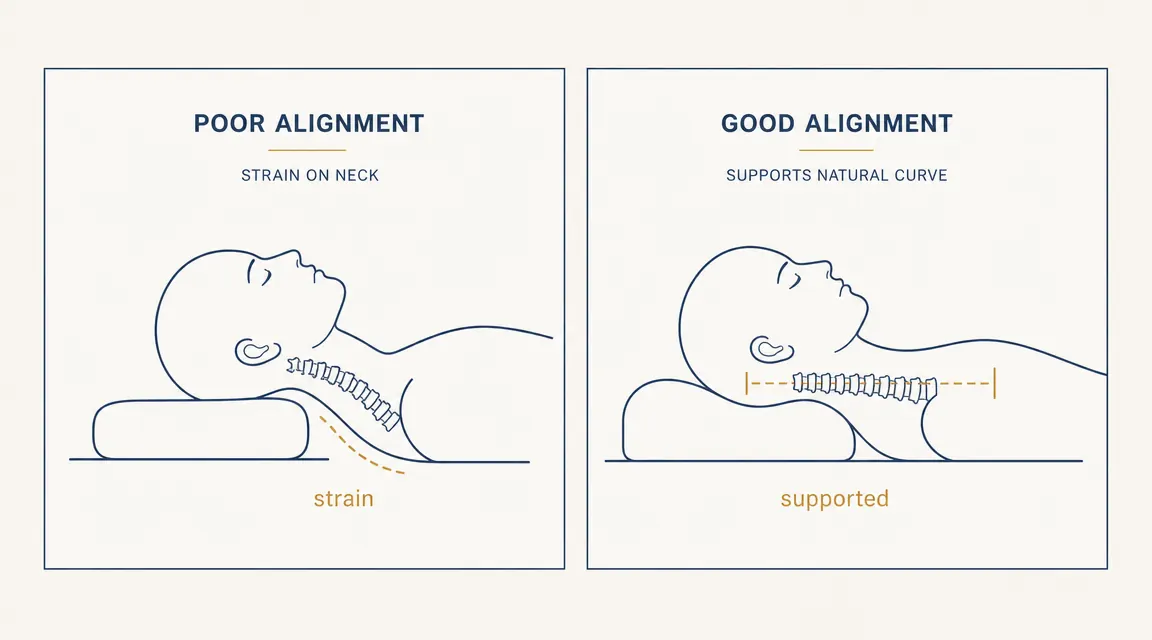
I am a side sleeper. Have been my entire adult life. And the problem with side sleeping on a pillow that is too flat is that your head drops toward the mattress. Not dramatically, not in a way you would notice when you climb into bed. But over seven or eight hours, that slight downward tilt puts a slow, sustained pull on the muscles along the right side of your neck. I favored my right side. My right shoulder was always the tender one. My right neck muscle was always the tight one. I had, for about four years, treated this as a mystery.

I tried the stretches my chiropractor sent me. They helped a little. I tried sleeping on my back for a few weeks. I lasted about three nights before instinct rolled me back over. I bought a new mattress in 2022, which helped my lower back but did nothing for my neck. The stiffness was always there waiting for me at 6:45am, reliable as my alarm.
What finally made me actually change the pillow was reading, in a journal article on cervical spine loading during sleep, that the ideal loft for a side sleeper is roughly the distance from your ear to the outside edge of your shoulder. I measured mine. My shoulder width was about five inches. My flat old pillow, when compressed under my head, was giving me maybe two. That gap is where three years of morning stiffness lived.
The ideal loft for a side sleeper is the distance from your ear to your shoulder. My pillow was giving me less than half that. That gap was where three years of morning stiffness lived.
I spent a few hours reading pillow reviews before landing on the Coop Home Goods Original Crescent. What sold me was not the 65,000-plus reviews, though that number is hard to dismiss. It was the adjustability. The pillow ships filled with shredded memory foam and a polyester-microfiber blend, and it comes with a bag of extra fill so you can add or remove material until you find the loft that works for your actual body. That is not something most pillows offer. Most pillows hand you a fixed shape and dare you to adapt to it.
Your neck stiffness might have a simpler fix than you think.
The Coop Home Goods Original Crescent adjustable pillow comes with extra fill so you can dial in the exact loft your shoulder width needs. Over 65,000 buyers, 4.5 stars. See today's price on Amazon.
Amazon Check Today's Price on Amazon →The pillow arrived with what felt like too much fill. My head sat noticeably high. I followed the instructions, removed two handfuls of foam, zipped it back up, and lay down. It was closer but still a touch firm on the underside. Another small handful out, and I had it. My head sat level. My neck ran in a straight line out to my shoulders. I know that sounds like a minor thing, but lying there in the right position for the first time in years felt genuinely strange, in the best sense.
By the end of the first week, I noticed I was reaching for my neck less in the mornings. By the end of week two, the right shoulder soreness had gone quiet. It did not vanish overnight in a cinematic way. It faded the way pain usually fades when you remove the thing causing it: gradually, almost without you noticing, until one morning you realize it has been several days since you thought about it.

There are things I want to be honest about. The pillow runs a little warm. Not intolerably so, and the breathable cover helps, but if you are a hot sleeper this is worth knowing. The break-in period is real: the foam had a faint smell the first night, which I solved by airing the pillow out for a day before sleeping on it. And at its current price, it is not a throwaway purchase. I thought about that price for a while before I ordered. I had also been paying for chiropractic visits twice a month. The math on that eventually straightened itself out.
I am also not going to tell you this will fix everything. If your neck pain has a structural cause, a pillow will not resolve it. What it can do is stop making things worse every single night, which is what my old pillow was quietly doing while I stretched and iced and puzzled over the source of my problem.
What I'd Tell You If We Were Sitting at My Kitchen Table
Here is what I would actually say to you: if you wake up with a stiff neck more mornings than not, and you have not looked seriously at your pillow, look at the pillow first. Before the specialist, before the fancy mattress, before the new stretch routine. The pillow is the thing touching your neck for eight hours. It deserves more scrutiny than most of us give it. I had a professional tell me this repeatedly, and I still managed to put it off for most of a year. The Coop Crescent is where I landed, and I have slept on it for the better part of six months now without any reason to look for something else. That, for a self-described chronic insomniac who reviews sleep products for a living, is about as close to an endorsement as I get. Take the ten minutes to read the full review, check the sizing guidance for your shoulder width, and order the right loft the first time. Your Tuesday morning self will be relieved you did.
Six months in, I still haven't looked for a replacement. That says a lot.
The Coop Home Goods Crescent adjustable pillow is what I switched to after years of morning neck pain. Adjustable fill, CertiPUR-US foam, free returns. See whether it's still at its current price.
Amazon Check Today's Price on Amazon →