
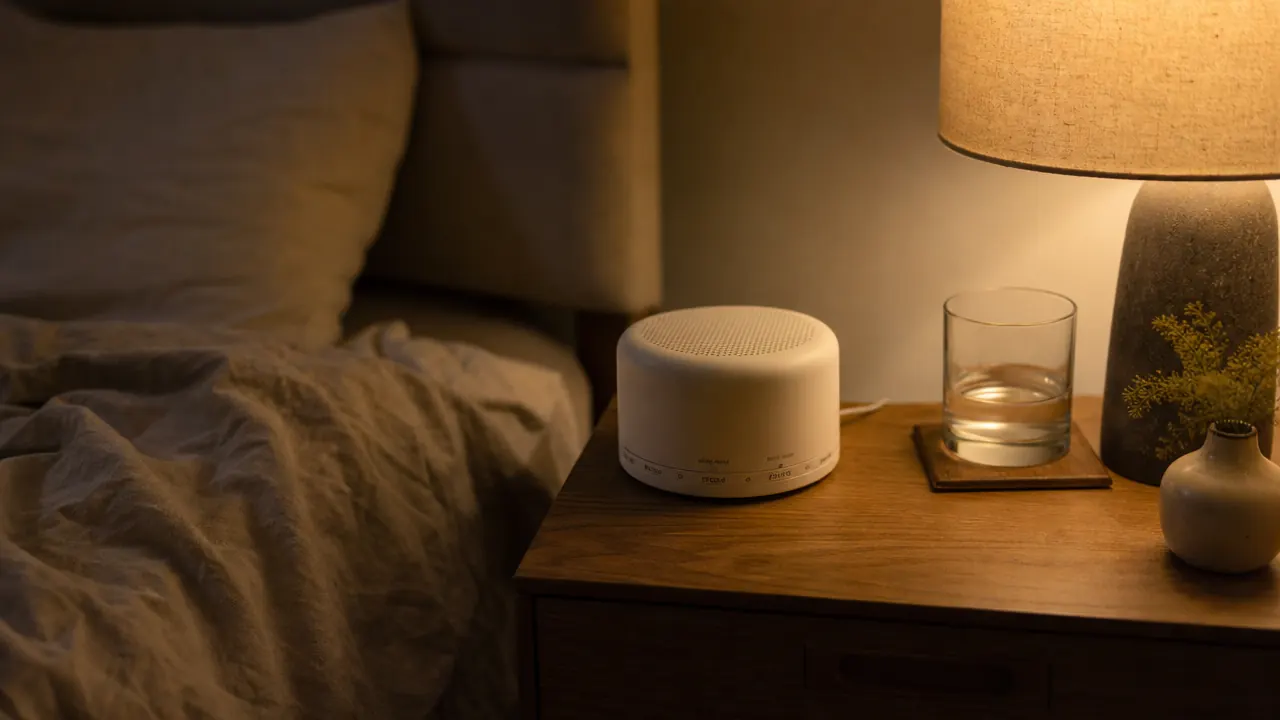
I ran a white noise machine the wrong way for about eight months before I figured out what was missing. I plugged it in on my side of the bed, turned it up loud enough to cover the traffic outside, and called it good. It helped, sort of. But I was still waking at 3am when my upstairs neighbor decided midnight was a reasonable time to rearrange furniture. It wasn't until I started reading sleep acoustics research and talking to other people who actually rely on these machines that I understood: placement, volume, and tone setting are not interchangeable. Get them wrong and you're leaving most of the benefit on the table.
This guide walks through the five steps that actually matter, built around the Yogasleep Dohm Classic as the reference machine. The Dohm is the original mechanical white noise machine, and its real-fan design gives you a range of tonal options that digital machines can't fully replicate. If you own a different machine, the steps still apply. The Dohm-specific notes are just the most precise because it's the one I've spent the most time with.
Still buying a machine? The Yogasleep Dohm Classic is the go-to for a reason.
4.6 stars across more than 40,000 reviews. Real fan, mechanical tone control, no loops, no Bluetooth dependency. If you haven't picked one up yet, check today's price before you start setting up.
Amazon Check Today's Price on Amazon →Step 1: Choose the Right Placement Zone
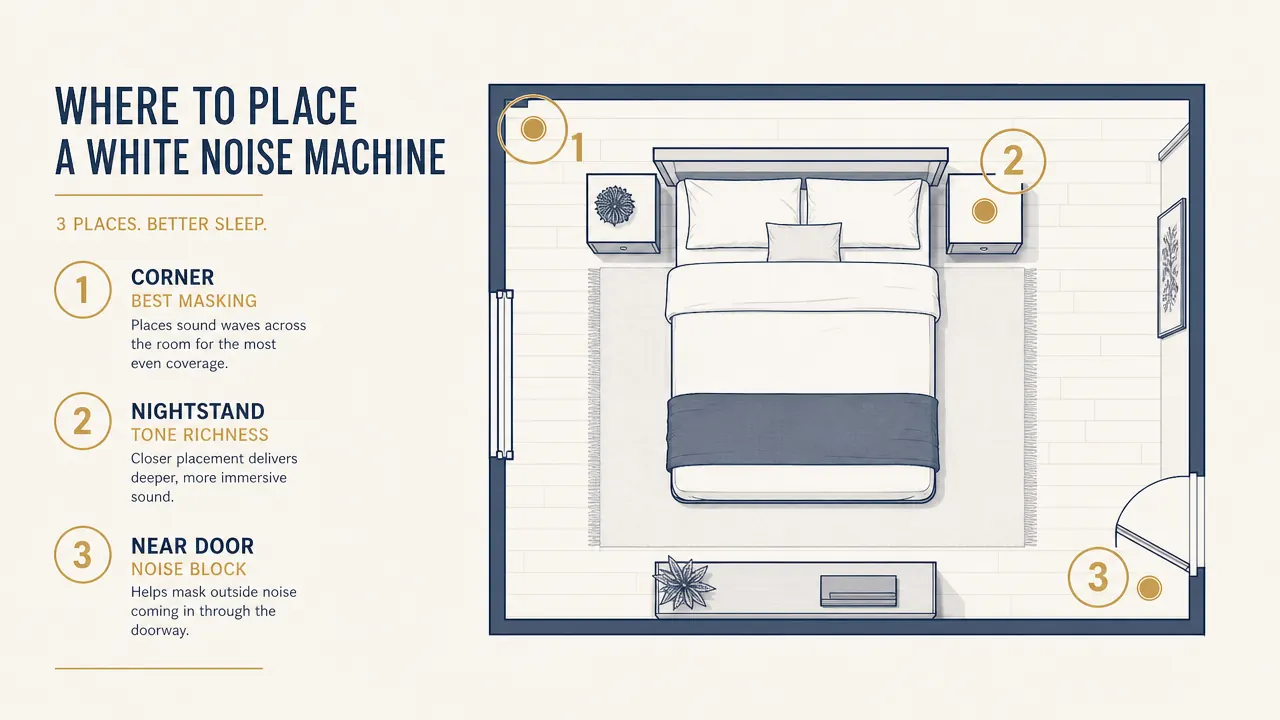
Most people put a white noise machine on the nightstand because that's where it's convenient. It is not always where it's effective. The goal of a white noise machine is to raise the ambient sound floor in the room so that sudden noise spikes, a car honking, a door slamming, a partner shifting, don't cross the threshold that wakes you. To do that, the sound needs to fill the room, not just come from one corner.
There are three placement zones worth understanding. Nightstand placement (two to four feet from your head) gives you the richest tone and the most intimate sound, good if the noise problem is internal, meaning a restless mind or tinnitus. Corner-of-the-room placement, where two walls meet, amplifies the sound via boundary effect and can cover a larger area at a lower volume. Near-door placement is the right call if your problem is noise coming in from a hallway, another room, or a shared wall. The boundary effect works here too, and positioning the machine between you and the noise source is the most direct acoustic solution.
For most adults dealing with urban noise or a noisy household, I recommend starting with the door-adjacent placement first. If you're also dealing with a racing mind or light sleep, move it to the nightstand once you've gotten the room noise under control. You can run a second smaller machine near the door if the space is large or if the noise problem is particularly bad. The Dohm is compact enough to work at any of these positions without being obtrusive.
Step 2: Set the Volume Before You Try to Sleep
The most common mistake people make with white noise machines is the same one they make with sleep aids in general: more is not better. If you are turning the volume up as high as it goes because you figure louder means better coverage, you will wake up with an oddly fatigued auditory system and possibly a mild headache. You are also training your brain to associate sleep with a sound level that, if anything, is stimulating rather than masking.
Research on white noise and sleep generally suggests a volume in the range of 50 to 65 decibels for adults. For context, normal conversation is around 60 decibels. You want the sound to be present and consistent, not commanding. A useful informal test: if you can hear the white noise easily when you're reading in bed, it is probably loud enough. If you have to actively listen for it, nudge it up slightly. If it's the loudest thing in the room and you're aware of it constantly, turn it down.
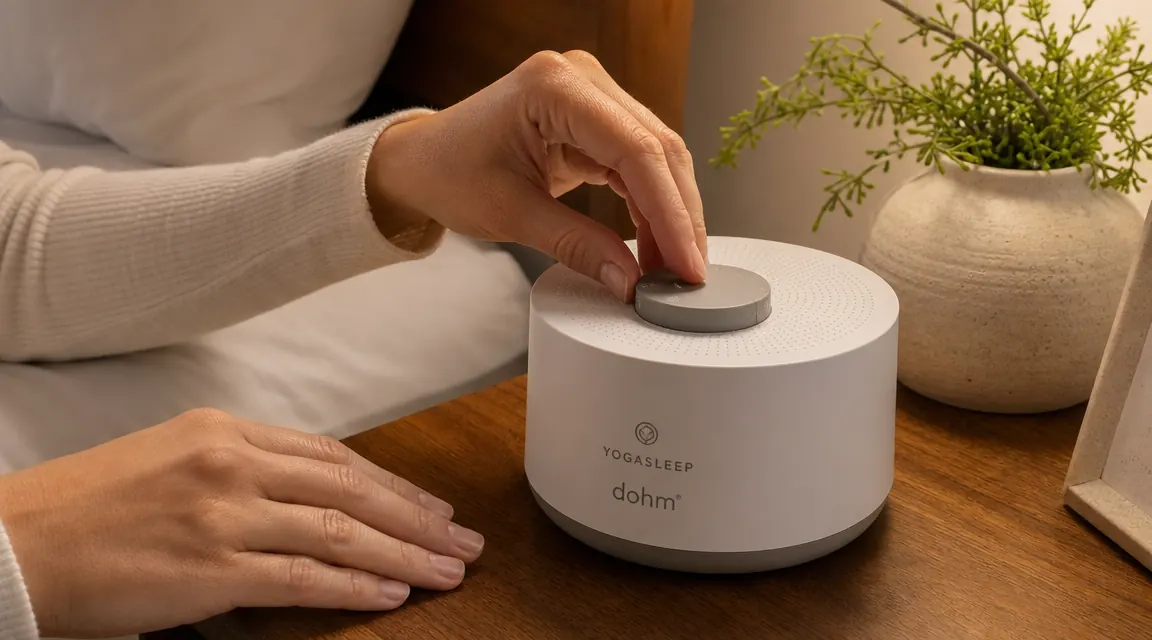
The Dohm has two volume positions: the low position is the default with the outer shell pulled toward you until it clicks, and the high position comes from rotating the shell the other direction until it seats. Most bedrooms with moderate noise problems do fine on the low setting. Save the high setting for noisy hotel rooms, apartments over restaurants, or nights when someone with a foghorn voice is talking in the hallway. Do not start on high and work backward. Start on low and only escalate if you genuinely need it.
Step 3: Dial in the Tone for Your Specific Problem
This is where analog fan machines like the Dohm genuinely outperform digital alternatives. The top dial on the Dohm rotates the fan housing inside the unit, changing the aperture through which air moves and therefore changing the frequency balance of the resulting sound. Turn it one direction and you get a lower, breathier rumble. Turn it the other direction and you get a higher, airier rush. The difference between the two extremes is significant and audible within the first two rotations.
Why does tone matter? Because different noise problems respond to different frequency ranges. Low-frequency snoring and traffic rumble are best masked by a fuller, lower tone. High-frequency voices through walls, television dialogue from another room, or the specific pitch of a smoke alarm beep in the distance respond better to a brighter, higher tone. Most people have a mix of both, which is why the middle range of the dial, slightly toward the lower side, tends to be where people settle after a few nights of adjustment.
The honest advice here is to spend two or three nights experimenting rather than trying to find the perfect setting on night one. Turn the dial slightly each night. Keep a note on your phone about which direction and by how much. You will notice a difference in how quickly you fall asleep and whether you're waking mid-cycle. The Dohm rewards patience. It is not a plug-in-and-forget device. It is a precision instrument masquerading as a small white cylinder.
The Dohm is not a plug-in-and-forget device. It is a precision instrument masquerading as a small white cylinder. Give it three nights of adjustment and you will understand why it's been the same design since 1962.
Step 4: Build a Pre-Sleep Routine Around the Sound
One underappreciated benefit of a white noise machine is how quickly it becomes a sleep anchor, a sensory cue that tells your nervous system bedtime is happening. This is the same mechanism behind why blackout curtains work better after a week than on night one: your brain associates the darkness with sleep onset and starts reducing cortisol faster in response. White noise can do the same thing if you use it consistently.
The practical version of this: turn the Dohm on 20 to 30 minutes before you get into bed. Not when you're already lying there trying to sleep, but while you're winding down, doing your skincare, reading, whatever the last 30 minutes of your night looks like. Let the sound be present during that wind-down. Over a week or two, your brain starts to register the sound as a pre-sleep signal. This shortens sleep onset time in a way that feels almost effortless, because it is. You're just stacking a conditioned response.
If you share a bedroom, this approach works even better. The machine creates a shared acoustic environment that signals wind-down for both of you simultaneously, rather than one person lying awake listening to the other still moving around. Couples who use the Dohm consistently often report that it became a mutual bedtime cue within two weeks of starting. That's not magic, it's just classical conditioning, and it costs nothing extra once you already own the machine.
Step 5: Layer It with Other Sleep Tools Strategically
A white noise machine solves an acoustic problem. It does not solve a light problem, a temperature problem, or a restless-mind problem on its own. The sleepers who get the best results are almost never using just one intervention. They're layering tools that each address a different failure point in the sleep environment.
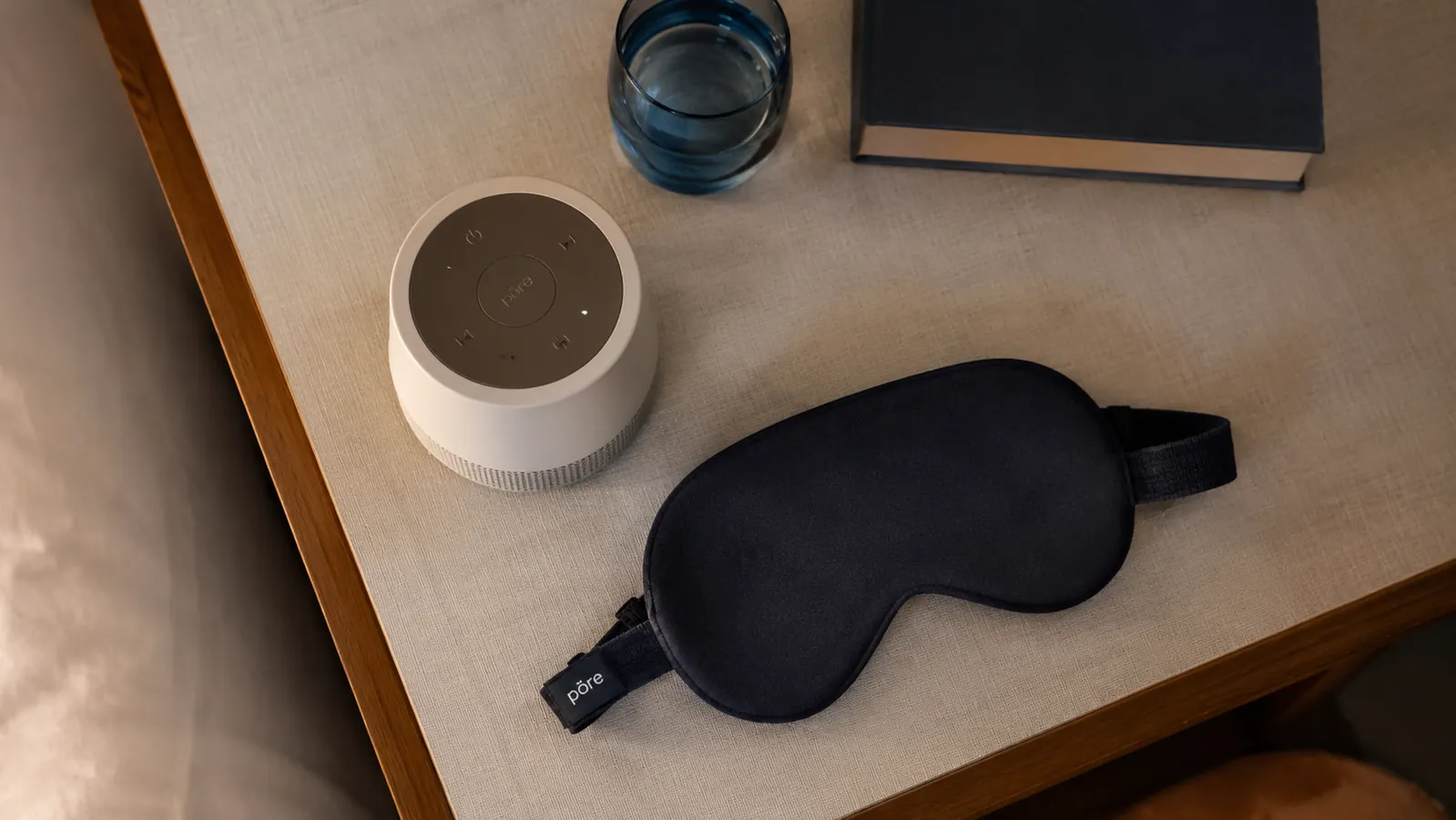
The most effective pairing with a white noise machine is a proper blackout solution, whether that's blackout curtains, a contoured sleep mask, or both. Light is one of the most powerful suppressors of melatonin production, and your bedroom is probably brighter than you think at 5am when the sun starts coming up. If you've fixed the noise problem but you're still waking early, light is usually the next culprit. I tested a blackout sleep mask alongside the Dohm for three weeks and found I was sleeping 45 minutes longer on average before my brain decided morning had arrived.
Temperature comes next. The ideal core body temperature for sleep onset is 1 to 2 degrees Fahrenheit below your daytime level, which is why most people sleep better in a cooler room. If your bedroom runs warm, a cooling mattress topper or breathable pillow tends to address this more effectively than air conditioning alone, because it targets the surface you're in direct contact with rather than the ambient air. A white noise machine doesn't interact with temperature, but solving the acoustic layer often reveals the temperature problem underneath. You're no longer waking because of noise, but now you're noticing that you're still waking, just for a different reason.
The one thing I'd caution against: do not try to fix everything at once. Add the white noise machine first, run it for two weeks, and assess what changed. Then decide what's still disrupting you. The systematic approach is slower, but it tells you what's actually working instead of leaving you with a bedroom full of sleep gadgets and no idea which one is doing what.
What Else Helps: The Honest Short List
After spending the better part of a decade taking sleep seriously, mostly because I had no choice once the second kid arrived, here is the honest short list of what pairs well with a white noise machine versus what is mostly placebo. Cooling sheets are legitimate, particularly if you're a hot sleeper, but they need to be combined with either a cool room or a cooling topper to actually lower your skin temperature meaningfully. A weighted blanket helps real people with anxiety-driven sleep fragmentation, the kind where you wake at 2am and cannot stop your brain from running through tomorrow's to-do list. An adjustable pillow helps if neck position is disrupting your sleep continuity, which is more common in side sleepers than anyone acknowledges. Melatonin helps for circadian rhythm shifts, like jet lag or a schedule change, but is largely overused as a general sleep aid when the actual problem is environment, not hormone level.
The white noise machine sits at the foundation of this stack because it addresses the most common and most immediate sleep disruptor: noise. Fix that first, then decide what else needs fixing. You might be surprised how much of the rest resolves on its own.
For a full side-by-side comparison of the Dohm against the other major machine on the market, see the Yogasleep Dohm vs LectroFan EVO comparison. And if you want my 60-night field notes on the Dohm specifically, the Yogasleep Dohm Classic review has more detail than you probably need, which is exactly the point.
Ready to set one up tonight? The Dohm is the machine this guide is built around.
Mechanical fan, analog tone dial, no app, no subscription. The same design since 1962, still the reference standard for real-fan white noise. Check today's price and see if it's the right fit.
Amazon Check Today's Price on Amazon →