
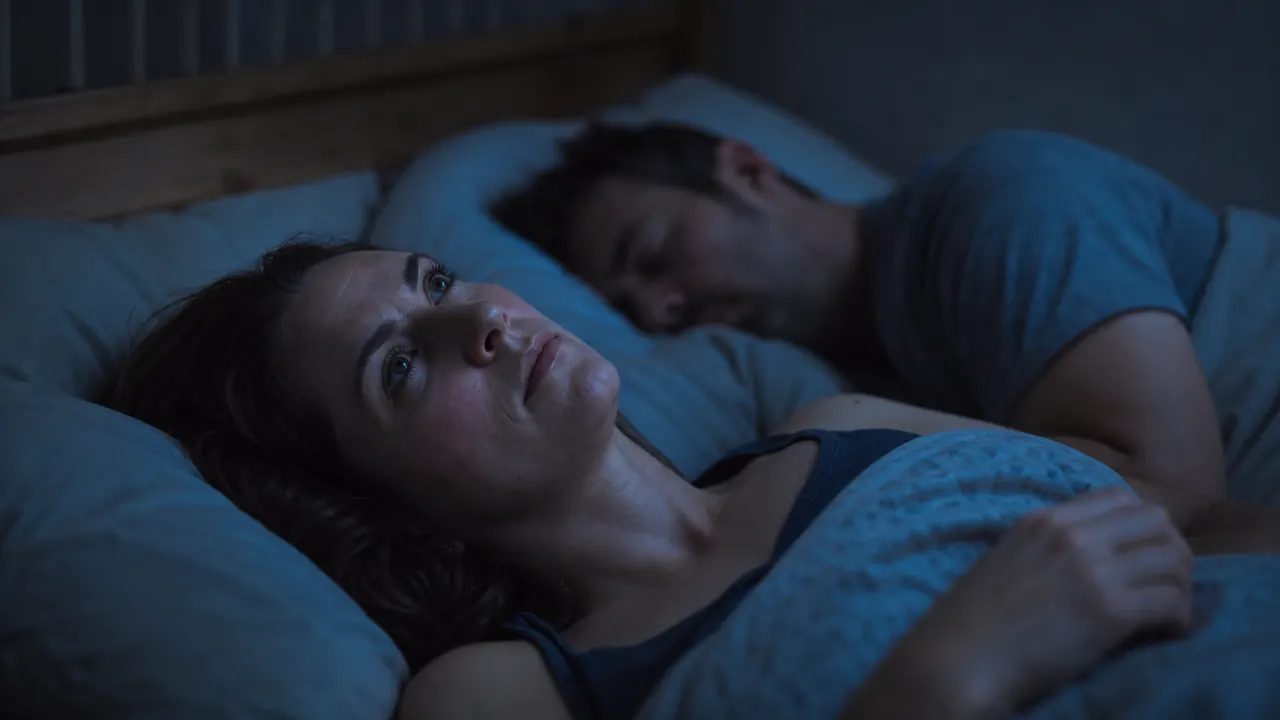
My husband, Tom, has snored since we were in our 30s. Back then I could sleep through almost anything. Two kids, a decade of broken nights, and one perimenopausal nervous system later, I could not. The snoring that once registered as background noise had become a precise and personal alarm clock set to go off at roughly 1:47am every single night. What saved my sleep was not earplugs and not a separate bedroom. It was a white noise machine, the Yogasleep Dohm Classic, sitting on the nightstand.
I want to be very clear: I love Tom. I also wanted to smother him with a pillow. Not in a criminal way. In a "please, for the love of everything, just stop" way. I think every light sleeper partnered with a snorer knows exactly what I mean.
I tried the usual things in the usual order. Foam earplugs, which worked until they fell out. Wax earplugs, which were better until they weren't. A sleep app that played rain sounds through my phone speaker, which meant sleeping with my phone face-up on the pillow, which introduced its own problems. One desperate week I slept in the guest room and felt both relieved and vaguely terrible about it. None of these fixed anything. They just shifted the location of the problem.
A friend who edits a parenting newsletter mentioned she had the same setup, and had used a white noise machine for years. Not a phone app. A dedicated machine, one that ran on a real fan motor rather than looped digital audio. She said it was the reason she and her husband still shared a bedroom after fifteen years. I filed that away, forgot about it for three months, remembered it at 2am on a Tuesday, and ordered the Yogasleep Dohm Classic before I'd fully thought it through.
It doesn't make Tom quieter. It makes the contrast between silence and snoring disappear. That turns out to be the thing that actually matters.
If your partner's snoring is costing you sleep, the Dohm is worth trying before you try anything else
The Yogasleep Dohm Classic uses a real fan motor to generate natural, non-looping white noise. 4.6 stars across more than 40,000 reviews. Affordable.
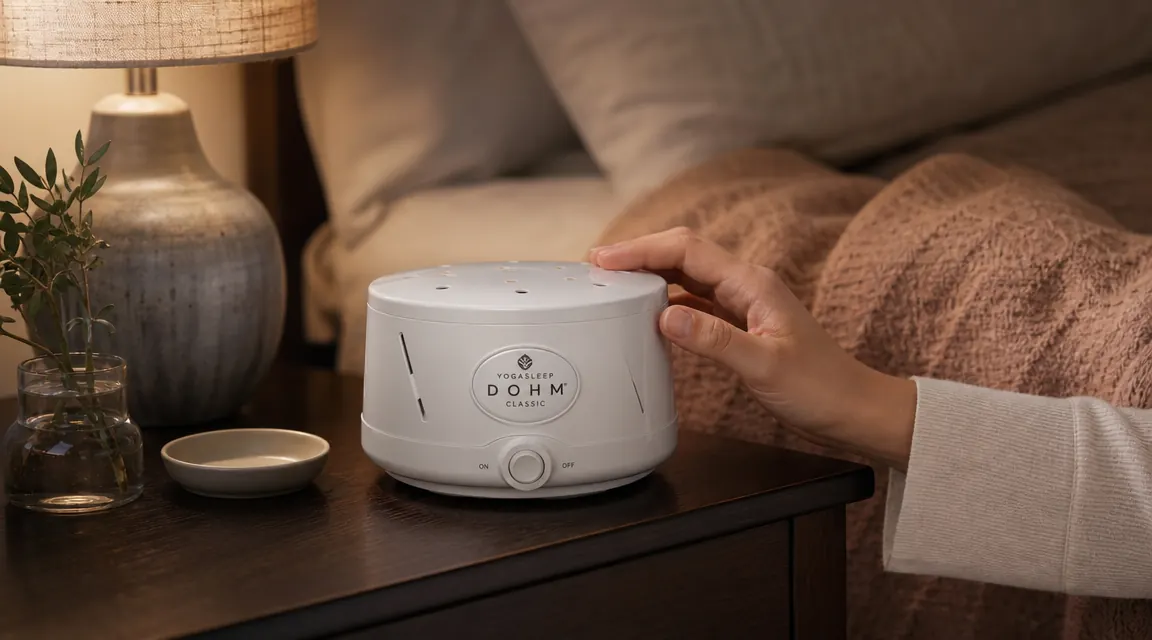
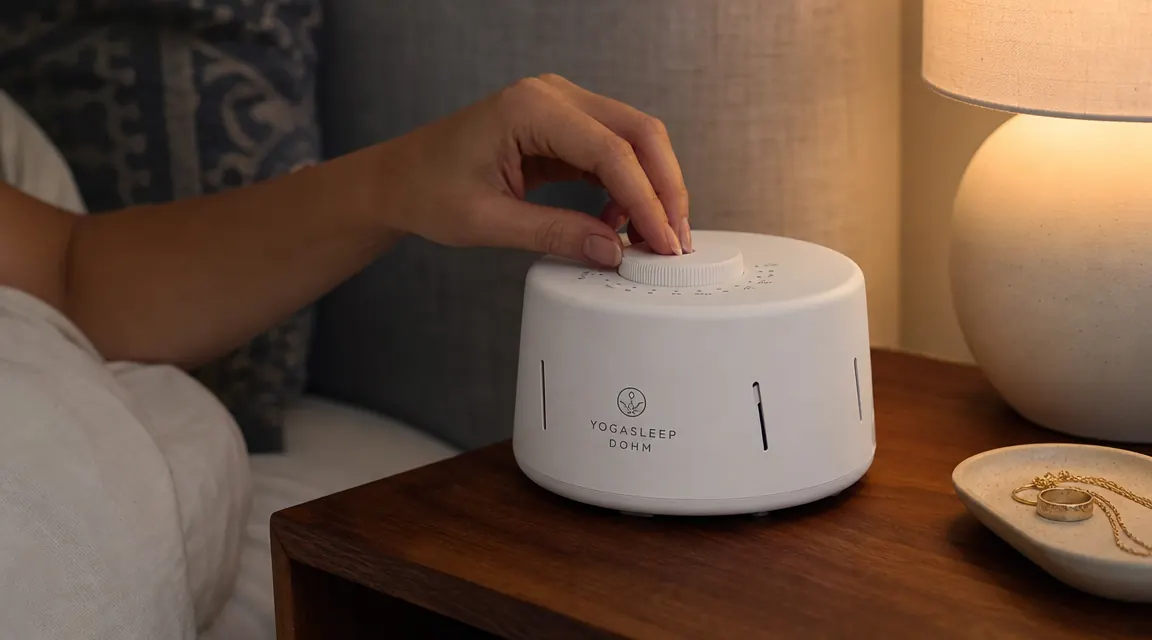
Amazon Check Today's Price on Amazon →The machine arrived and I stood in the kitchen holding a small white cylinder about the size of a large coffee mug. It looked low-tech in the best possible way. There is a dial on the top to adjust tone, and a ring around the middle to adjust volume. That's it. You plug it in, you turn it on, you rotate those two surfaces until you find the sound that covers the frequencies you need to cover. The whole setup took about four minutes.
The first night I used it, I woke up once. Not because of snoring. Because I heard a car outside and briefly wondered if I'd actually slept. I had. For five and a half consecutive hours, which was, at the time, something close to a miracle.
The way the Dohm works is not complicated, but it is different from what I expected. It doesn't cancel sound the way noise-canceling headphones do, and it doesn't mask it with a competing sound the way a rain app does. What it does is fill the silence around the snoring so that the snoring stops being a sudden interruption. Your brain, which is wired to jolt awake at sharp changes in sound level, stops registering the snore as a threat. The contrast disappears. I stayed asleep because there was nothing jarring enough to drag me out.
There are real trade-offs worth mentioning. The Dohm has a finite volume ceiling. If your partner is a genuinely loud snorer, loud enough to hear through a closed door, you may need to run it at maximum volume, and even then there will be nights when it doesn't fully work. It also needs to be fairly close to your head, which means your nightstand placement matters. And unlike a phone app, you can't pick from thirty different sound profiles. You get white noise. One kind of white noise. For most people that turns out to be enough, but if you've tried white noise and found the high frequencies irritating, the Dohm's analog fan sound is softer and warmer than most digital options, which is worth knowing.
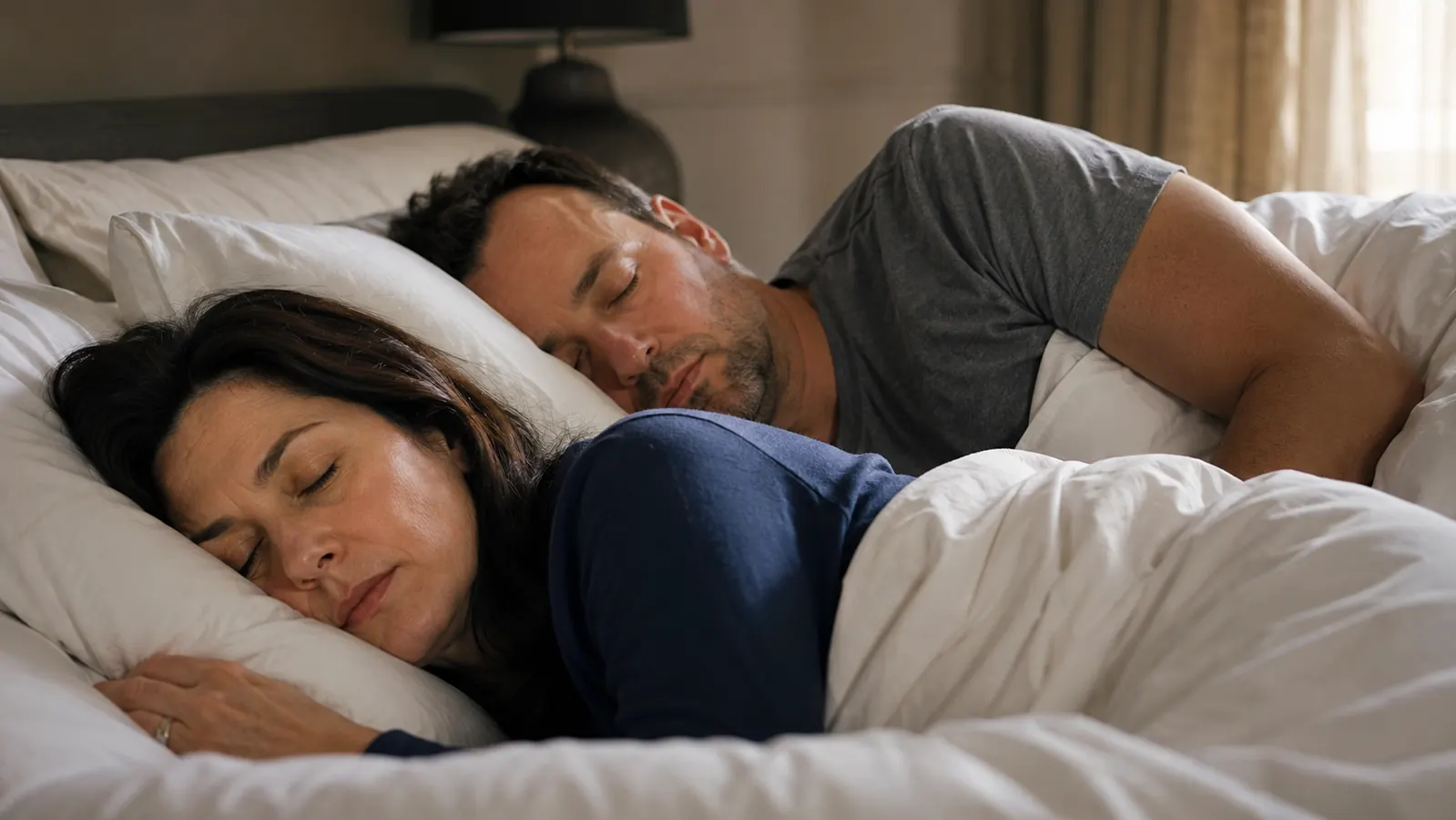
I've been using it every night for about nine months now. Tom still snores. I still hear it sometimes, usually on the nights when I wake up anxious about something else and my brain is already running hot. But it stopped being the central fact of my sleep life, and that shift was larger than I expected it to be. The guest room has gone back to being a guest room.
What I'd Tell You If We Were Sitting at My Kitchen Table
If you're in the same situation I was, here is what I would actually say. The Dohm is not a cure for snoring. If you're hoping to fix the snoring itself, this is not that. What it does is give you a way to sleep in the same room without the snoring becoming your emergency. That is a different kind of solution and, honestly, a more realistic one for most couples.
It's also not the most exciting thing you can spend money on. There's no app, no Bluetooth, no sleep tracking. It's a small machine with a fan in it. But for something budget-friendly that you plug in once and then leave on your nightstand for years, the value-to-simplicity ratio is hard to argue with. If you read the reviews on Amazon, you'll see a lot of people who've owned theirs for five or ten years. That's the tell.
I'm not going to tell you it will work for everyone. What I'll tell you is that it worked for me, that it costs less than a night in a hotel, and that the worst realistic outcome is that you return it. Given that I spent three years being miserable at 2am, I wish I'd tried it sooner.
Budget-friendly, real fan motor, 40,000+ reviews, and you can return it if it doesn't work
The Yogasleep Dohm Classic is the machine sleep researchers recommend most often for snoring-disrupted sleep. Check the current price before you talk yourself out of it.
Amazon Check Today's Price on Amazon →